
Most businesses believe they have an AI adoption strategy. They bought the licenses. They ran a lunch-and-learn. Someone on the team automates their emails now.
That is not a strategy. That is a coping mechanism.
The businesses that win over the next few years will not be the ones that added AI to their existing operations. They will be the ones that rethought their operations around AI. This article walks through why the common approaches fail, and gives you the planning exercise that reveals how deep your AI transformation actually needs to go.
The two ways businesses adopt AI today (and why both fail)
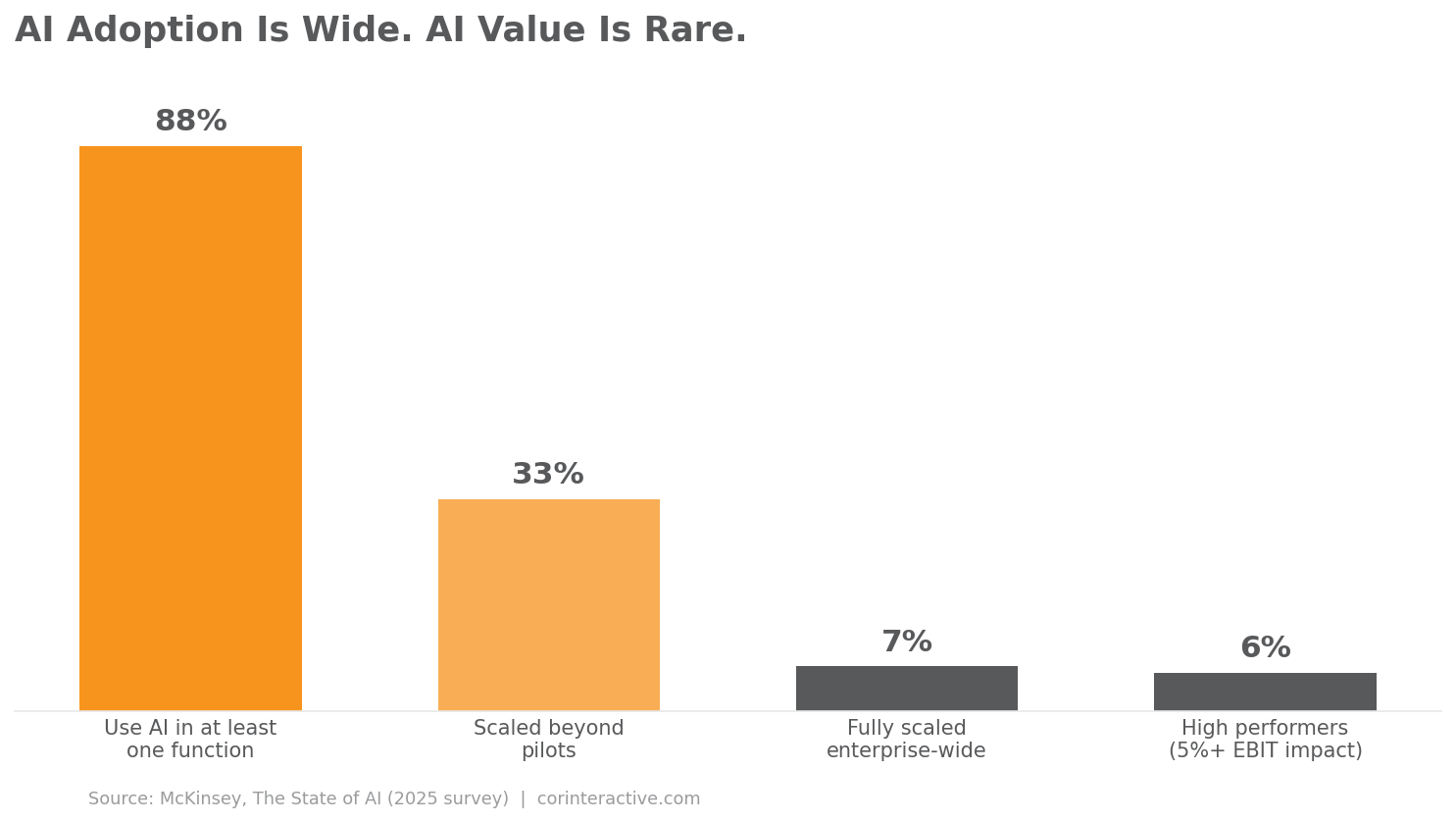
Watch how established companies handle AI right now and you'll see two patterns. And to be clear, nearly everyone is doing something: McKinsey's 2025 State of AI survey found 88% of organizations now use AI in at least one business function, up from 55% just two years earlier. That's one of the fastest enterprise adoption curves ever recorded.
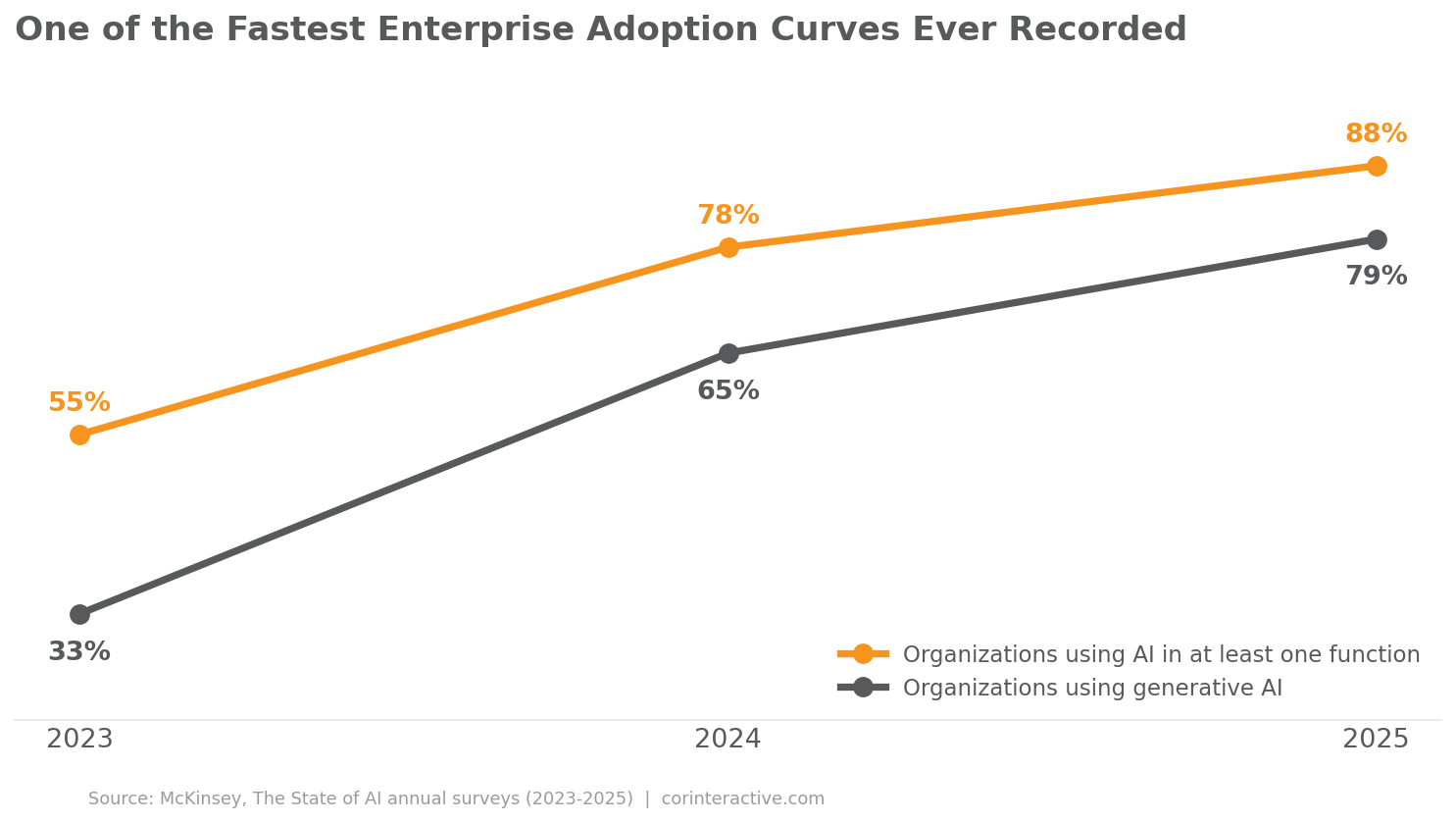
Usage is not the same as results, though. The same research found only about 7% of organizations have fully scaled AI across the enterprise, and only around 6% qualify as high performers attributing real profit impact to AI. Adoption is wide. Value is rare. The two patterns below explain the gap.
Pattern one: hand it to the team and hope. Leadership distributes AI tools with no structure, no guidance, and no shared standards. Every employee uses AI differently. Quality is inconsistent. Nobody measures anything. Nothing compounds. This is AI adoption by press release.
Pattern two: audit the old system and bolt AI on. More engaged leaders map their existing processes and ask which ones AI could take over. This feels responsible. It produces committees, pilots, and roadmap decks.
It's still the wrong move, and here's why. Your current processes exist because humans had to do the work. Every handoff, approval step, meeting, and file format assumes a person at a keyboard. When you bolt AI onto that system, you're polishing a machine designed for a world that's ending. You get a slightly faster version of 2018.
Meanwhile, a new class of competitor is being built without any of that baggage.
What is an AI-native company (and why it's your real competition)
An AI-native company is a business designed from day one with AI doing the production work. Its processes, tools, and org chart all assume AI at the center, with humans positioned where they add unique value.
These companies are launching right now in nearly every industry. They carry lower overhead, move faster, and scale output without scaling headcount at the same rate. Within a year or two, they compete directly with established players. That includes you.
Mark Cuban put it bluntly: "There are 2 types of companies. Those that are great at AI, and those who will go out of business." He has also predicted the next several years of enterprise AI will be a mess, as companies fight the integration and consistency problems that come with every model provider running its own walled garden.
Both things are true at once, and that's the point. AI adoption isn't an efficiency project — it's a survival requirement with a deadline, and the road there is genuinely messy. The right response isn't to move faster on the bolt-on plan. It's to run a different plan entirely.
The AI-first exercise: plan as if AI does all the work
Here's the planning exercise every business should run, whether you launched last quarter or last century.
You won't actually run your company this way. The exercise matters because of what it forces you to document. It functions as the most honest AI readiness assessment you can do, and it costs nothing but a few working sessions. Work through these four questions.
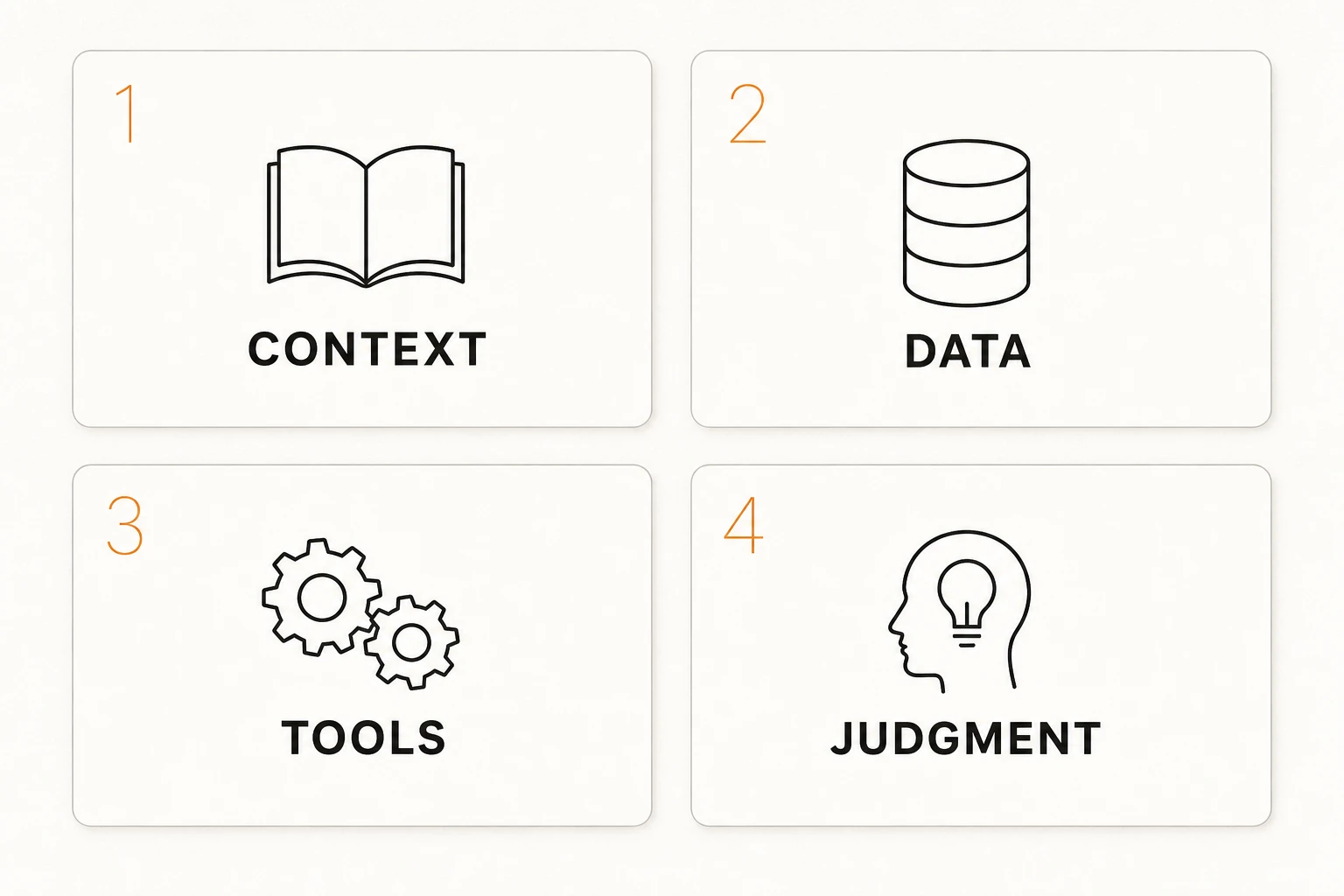
1. What context would AI need to do every job in your organization?
Go role by role. For each job, list everything a brand-new expert hire would need to know to perform it well. Pricing logic. Brand voice. Client history. Quality standards. Escalation rules. The unwritten stuff.
This is where most companies get uncomfortable. Critical knowledge usually lives in a few people's heads, a shared drive with no naming convention, and a folder called FINAL_v7.
The output of this question is the blueprint for your AI knowledge base: a centralized, documented, machine-readable version of everything your company knows. Building one pays off three times over. AI systems perform dramatically better with real context, every human you hire onboards faster, and the same structured knowledge is what makes your brand legible to the AI systems your buyers are asking for recommendations.
2. What data would AI need access to?
CRM records. Analytics. Financials. Project histories. Support tickets. Past deliverables and their outcomes.
Now check the honest version: can anything actually reach that data? If it sits locked in a tool with no export, scattered across personal drives, or trapped in PDF attachments, it can't power AI workflow automation. It can barely power your Monday meeting.
This question produces your data architecture priorities. Consolidate, structure, and connect before you automate.
3. What tools would AI need to interact with?
List every piece of software your business runs on. For each one, ask whether AI can connect to it. Does it have an API? Does it support MCP (Model Context Protocol, the emerging standard that lets AI models securely operate other software)? Is there a command line interface?
This audit gives you two lists: the integrations to build first, and the tools to replace. A platform that can't talk to AI in 2026 is a liability on your 2028 balance sheet. It's usually less work than teams expect — we published a worked example of pulling job data out of a closed CRM with nothing but its API and a script, no middleware required.
4. Which tasks run on human judgment, and can you capture it?
This is the hard one, and the one most businesses skip. Some work depends on intuition and taste built over years. The sense that a proposal reads wrong. The judgment call on a delicate client email. The pricing instinct on an unusual deal.
Leaders skip this category because they assume AI can't touch it. That assumption is wrong twice. AI already handles more judgment work than most executives realize, and its capability improves every quarter.
So start capturing expertise now. Record your best people working through real decisions. Document the reasoning, not just the outcome. Collect as many worked examples as possible. These become the training material and quality benchmarks for reliable AI systems later, and better onboarding material for humans today. This is also where you'll discover which processes need serious quality controls before you trust AI with them.
Will AI replace jobs? The wrong question for business owners
Everything above sounds like a headcount reduction plan. It isn't, and treating it as one misses the strategic payoff.
The standard approach assumes humans do all the work, then hunts for spots where AI can help. Flip it. Assume AI does the production work. Build systems for that. Then identify where humans create value AI can't, and invest heavily there.
That last part becomes your differentiator, and you need one. "We're great at using AI" won't qualify. Within a few years, every surviving competitor will be great at using AI. The ones that aren't will be gone.
AI proficiency is table stakes. Your differentiator has to be something else.
Durable differentiation lives where people prefer people. Consider account management. Could AI handle most of the mechanical work within a few years? Probably. But clients want a human who knows their business, answers the phone, and cares about the outcome.
Picture the structure that creates: AI systems deliver high-quality production work at scale. Your account managers, freed from that work, spend all their time on relationships, strategy, and judgment. Your differentiator becomes having the best account managers in your market.
The economics work too. When AI produces the baseline value, your people only need to add 10 or 20% on top to make the payroll math a clear win.
Enterprise AI adoption: running the exercise at scale
Everything above applies whether you run a five-person agency or a five-thousand-person enterprise. What changes at enterprise scale is the surface area, and the failure modes.
Large organizations face three problems small businesses don't.
Pilot purgatory. Enterprises are excellent at launching AI pilots and terrible at graduating them. A proof of concept succeeds in one department, then dies in procurement, security review, or org politics. The data here is brutal. MIT Media Lab's Project NANDA — drawing on 150 executive interviews, a survey of 350 employees, and an analysis of 300 public AI deployments — found that 95% of generative AI pilots deliver no measurable return, against an estimated $30–40 billion in enterprise investment. The funnel tells the story: about 60% of companies evaluated custom AI tools, only 20% got a pilot running, and just 5% reached production with measurable value.
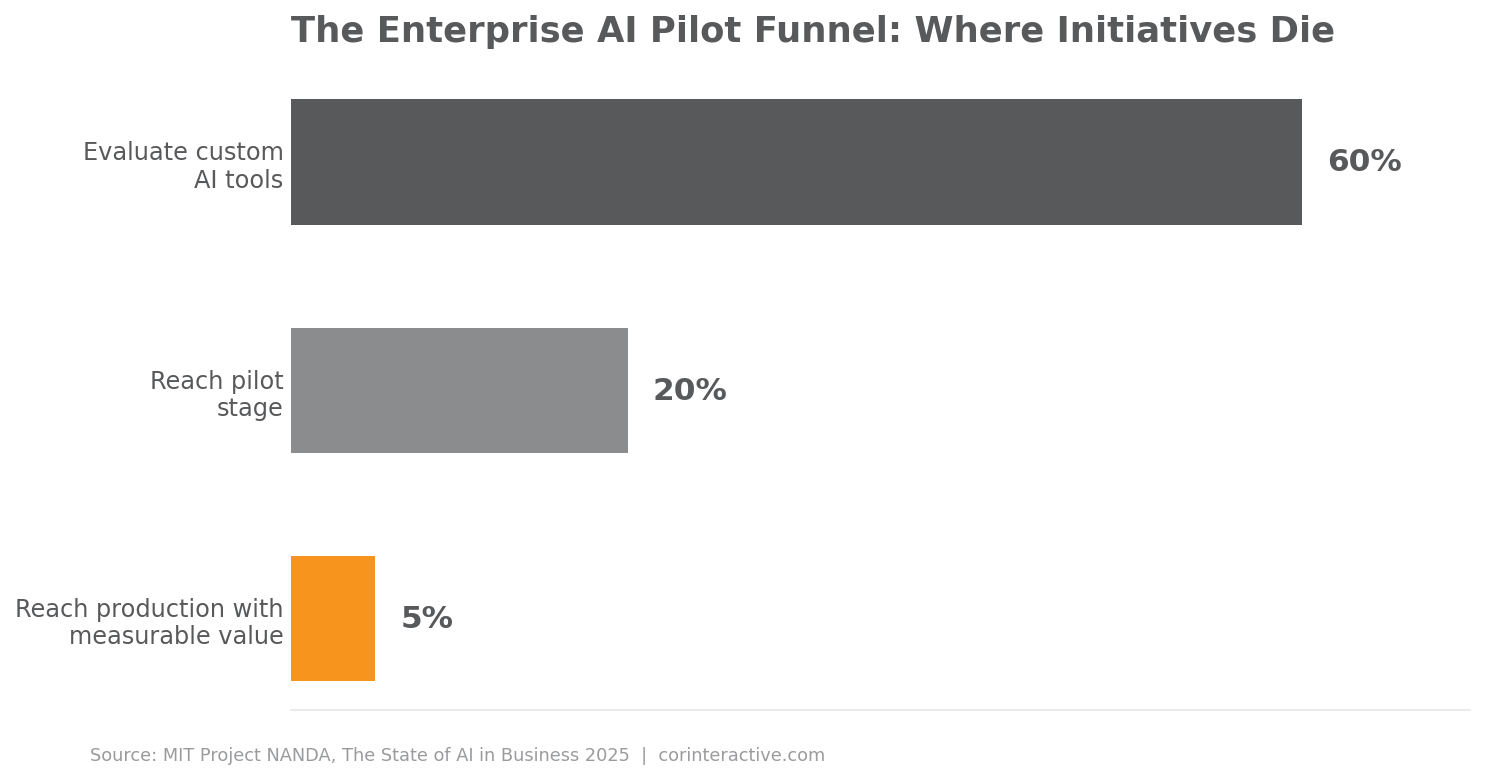
The MIT researchers were explicit that the divide isn't driven by model quality or regulation. It comes down to approach. The 5% that succeed embed AI deep in high-value workflows with real context and feedback loops. The fix is structural. Run pilots against a production standard from day one, with a named owner, a budget line, and a kill-or-scale decision date.
Fragmented adoption. Marketing buys one platform. Sales buys another. Engineering builds its own. Each silo gets a local win, and the company gets no compounding effect because the context, data, and standards never connect. The MIT study also documented a "shadow AI economy" underneath this: employees at over 90% of surveyed companies regularly use personal AI tools for work, while only about 40% of companies have official enterprise subscriptions. Your people are already adopting AI. The question is whether the company captures that energy in a system, or lets it stay invisible and ungoverned. This is where an enterprise AI strategy earns its keep. It's less about picking tools and more about mandating shared foundations: one knowledge architecture, one data access layer, one integration standard, one set of quality controls.
Governance as an afterthought. At enterprise scale, AI governance stops being optional paperwork. You need clear rules for what data AI systems can access, who reviews outputs in regulated workflows, how you audit decisions, and what happens when a system produces a wrong answer with a client's name on it. Companies that build governance into the workflow design move faster than companies that add it later, because their legal and security teams stop being blockers and start being co-authors.
The practical vehicle for all three is an AI center of excellence: a small cross-functional team that owns the knowledge base, the integration standards, the governance rules, and the pilot-to-production pipeline. Not a committee that meets monthly. A team that ships.
The four-question exercise still applies. You just run it per business unit, then reconcile the answers into one shared architecture. In our experience most of the context, data, and tooling requirements repeat across departments — which is the good news. Build the foundation once, and every subsequent workflow gets cheaper to launch.
McKinsey's research backs the approach. Its AI high performers are nearly three times as likely as everyone else to fundamentally redesign workflows as part of AI development, rather than layering AI onto existing processes — 55% of them versus 20% of the rest. That's the same conclusion the AI-first exercise forces, backed by survey data from nearly 2,000 organizations across 105 countries.
The future of business automation: from tools to agentic workflows
It helps to know where this is heading, because the target is moving.
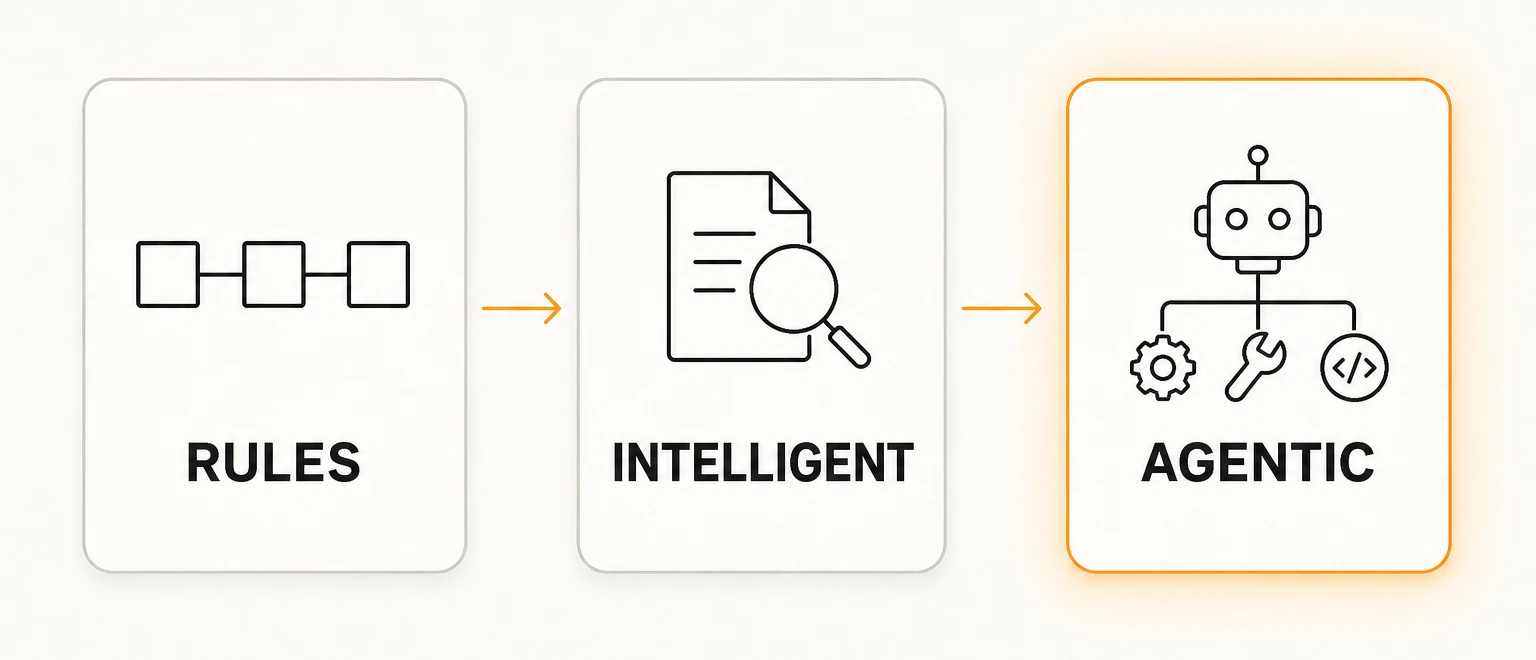
Where we came from. Traditional business process automation was rule-based. If invoice received, then route to approver. It handled structured, repetitive work and broke the moment anything varied. Intelligent automation added machine learning on top, so systems could read documents, classify requests, and handle some variation.
Where we are. Today's AI can reason through ambiguous work: drafting, analyzing, deciding, and adapting mid-task. The unit of automation has shifted from the task to the workflow.
Where it's going. The next phase is agentic workflows: AI agents that take a goal, break it into steps, use your tools, check their own work, and hand off to humans only at defined judgment points. Instead of a person driving software with AI assistance, an agent drives the software and a person supervises outcomes.
Expect turbulence on the way there. Gartner projects that over 40% of agentic AI projects will be canceled by the end of 2027, citing escalating costs, unclear business value, and inadequate risk controls — which is the pilot-purgatory pattern repeating at the next capability level. The winners won't be the earliest adopters. They'll be the companies whose foundations let agents actually work. Analysts call the broader trend hyperautomation, the systematic automation of every process that can be automated. The label matters less than the direction: the share of screen work that requires a human keeps shrinking, quarter after quarter.
Two planning implications follow.
First, AI orchestration becomes a core competency. When you run one AI workflow, you manage a tool. When you run thirty, you manage a system: agents that trigger each other, share context, escalate exceptions, and log their work. The companies investing in orchestration now — meaning the connective layer of routing, monitoring, and quality control — will scale agentic workflows in weeks while competitors rebuild plumbing for every new use case.
Second, design for capability you don't have yet. Any workflow you architect today should assume the AI doing it will be meaningfully better in twelve months. Build the context, data access, and quality benchmarks now, even for judgment-heavy work that current models handle imperfectly. When capability crosses the threshold, you flip the switch. Companies that wait for perfect capability before preparing will start their two-year foundation build exactly when their AI-native competitors finish theirs.
This is why the four-question exercise isn't a one-time audit. It's a standing planning discipline. The answer to "what can AI do in our business?" changes every quarter, and only companies with the foundations in place can act on the new answer.
Your AI implementation plan: how far to plan, and when to start
Here's the honest answer to "how much do we need to plan for AI?" More than a tool rollout. Less than a moonshot. Plan to the depth of your systems, on a two-year clock.
A realistic sequence:
- This quarter. Run the AI-first exercise with your leadership team. Answer the four questions on paper. Score yourself honestly on knowledge, data, tools, and captured judgment. That's your AI readiness assessment.
- Next two quarters. Build the knowledge base. Consolidate your data. Start the integration work on your most-used tools. Begin recording expert judgment in your two or three highest-value workflows.
- Quarters three and four. Stand up your first end-to-end AI workflows in production, with quality checks and a human owner for each. Measure output, not activity.
- Ongoing. Decide where humans are your edge. Hire and develop for those roles. Revisit the four questions every six months, because the answer to "can AI do this?" keeps changing in one direction.
The businesses thriving in 2028 are making these structural decisions in 2026. The ones still running pilots on top of 2018 processes will be competing against AI-native companies with half the cost base.
Frequently asked questions
What is an AI adoption strategy?
An AI adoption strategy is a plan for restructuring how work gets produced so AI can do the production work — covering the knowledge, data, tool integrations, and quality controls AI systems need. Buying licenses and encouraging employees to use AI is tool distribution, not a strategy.
How is AI used in business today?
The most common uses are content production, customer communication drafts, data analysis, research, and process automation. The gap between companies isn't which tools they use. It's whether AI runs inside structured workflows with context and quality standards, or gets used ad hoc by individual employees.
Why do most AI adoption strategies fail?
Because they layer AI onto processes designed for humans. Every handoff, approval step, and file format in a legacy process assumes a person at a keyboard, so automating it produces a slightly faster version of the old system. McKinsey found AI high performers are roughly three times as likely to fundamentally redesign workflows rather than add AI to existing ones.
How do I implement AI in my business without breaking what works?
Start with the AI-first exercise above rather than a tool purchase. Document context, connect data, and pick one high-value workflow to rebuild end to end. Run it parallel to your existing process until it beats it. Then move to the next workflow.
What is an AI readiness assessment?
An AI readiness assessment scores whether your business can actually support AI systems: whether critical knowledge is documented, whether your data is accessible, whether your software can be operated by AI through an API or MCP, and whether expert judgment has been captured. It measures foundations, not enthusiasm — which is why the four questions above work as one.
How will AI affect business in the future?
Expect production costs to keep falling for any work done on a screen, and expect AI-native competitors in most industries. The durable advantages shift to proprietary knowledge, data, client relationships, and the human judgment you've systematically captured.
Will AI replace my employees?
For most businesses, the smarter play is repositioning rather than replacing. Let AI absorb production work and move your people toward relationships, strategy, and judgment. Many companies running this playbook are still hiring, because each hire now leverages an AI system instead of doing everything manually.
How do I get buy-in for AI adoption in my organization?
Run the AI-first exercise as a team, not as a mandate. When your people map the four questions themselves, they see where AI removes drudge work and where their judgment becomes more valuable, not less. Pair that with a clear statement about roles, then prove it with your first workflow.
How do I measure AI adoption?
Skip vanity metrics like "percent of employees using AI." Measure workflow outcomes: production cost per deliverable, turnaround time, quality scores, and revenue per employee. If those aren't moving, your adoption is cosmetic.
What are agentic workflows?
Agentic workflows are processes where an AI agent receives a goal, plans the steps, operates your software to execute them, and checks its own output, escalating to a human only at defined judgment points. They're the successor to task-level automation, and the reason your integration and data foundations matter now.
What is AI orchestration?
AI orchestration is the layer that coordinates multiple AI systems: routing work between agents, sharing context, monitoring quality, and escalating exceptions. It becomes essential once you move past one or two isolated AI workflows toward automation across the whole business.
What is MCP and why does it matter for my business?
MCP (Model Context Protocol) is an open standard that lets AI models securely connect to your software, files, and data. It matters because it determines whether AI can actually operate inside your tools or just chat about them. When evaluating software going forward, "does it support MCP or an API?" belongs on your checklist.
Sources
- McKinsey & Company, "The State of AI in 2025: Agents, Innovation, and Transformation" — survey of 1,993 respondents across 105 countries, November 2025.
- MIT Media Lab, Project NANDA, "The GenAI Divide: State of AI in Business 2025" (via Forbes coverage), August 2025.
- Gartner, "Gartner Predicts Over 40% of Agentic AI Projects Will Be Canceled by End of 2027", June 2025.
- CNBC, "Mark Cuban: Companies can either be 'great at AI' or risk being 'put out of business'", March 2025.